← All work

Snapshot

Restraint, against the gravity of more.

An in-house backtesting capability, discovery to tested design in eight weeks. A market differentiator built by holding a line against everyone who wanted one more thing on screen.

Client
J.P. Morgan
Sector
Strategic Indices
Role
Lead designer
Year
2022
Status
Designed and tested, 0 to 1
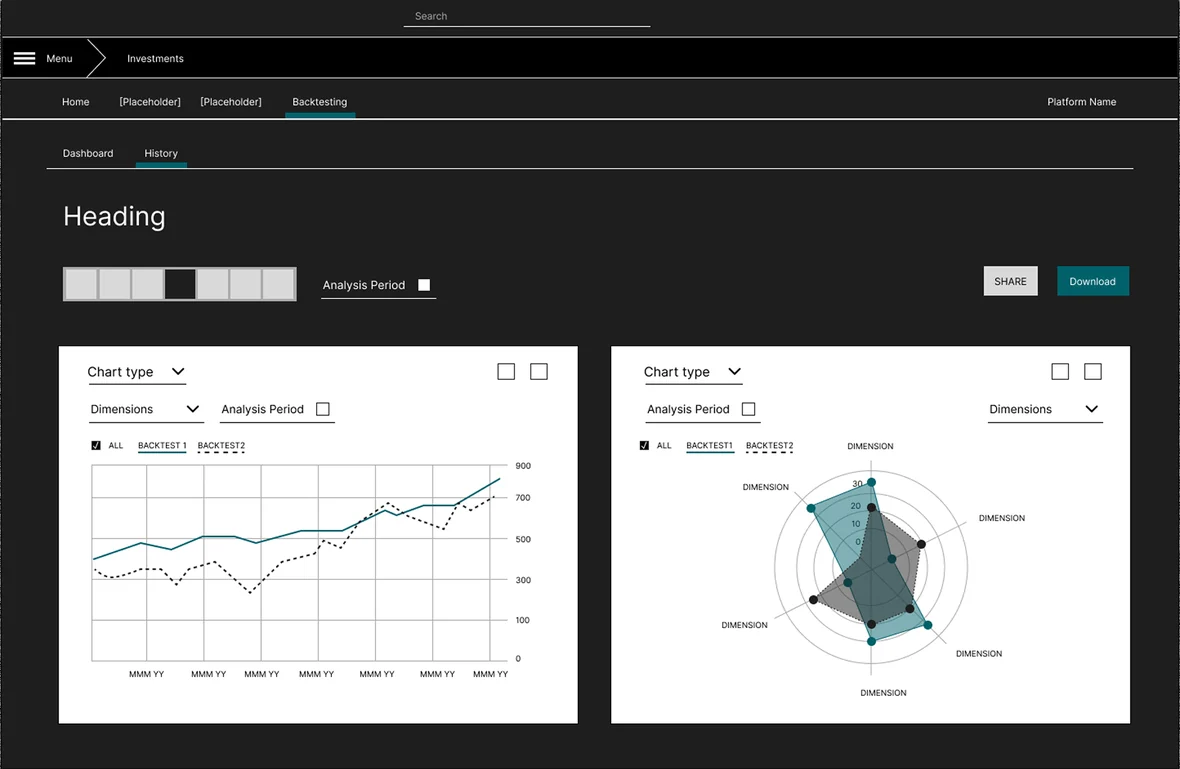
The backtesting workspace as shipped: a period selector, share and download, and two chart panels side by side, one plotting two backtests against each other over time and one comparing them across dimensions on a radar.
The shipped design, labels redacted Two backtests, two ways of reading them, and a period selector. Every control on this screen is one of the four the trader asked for. The words are stripped because the client required it, which is what an NDA leaves you: the layout survives, the reasoning does not.

The problem

Backtesting, simulating how a trading strategy would have performed historically, is essential for managing risk and validating an approach. Most banks don’t offer it in-house. They sell indices, then leave clients to third-party tools they find hard to navigate.

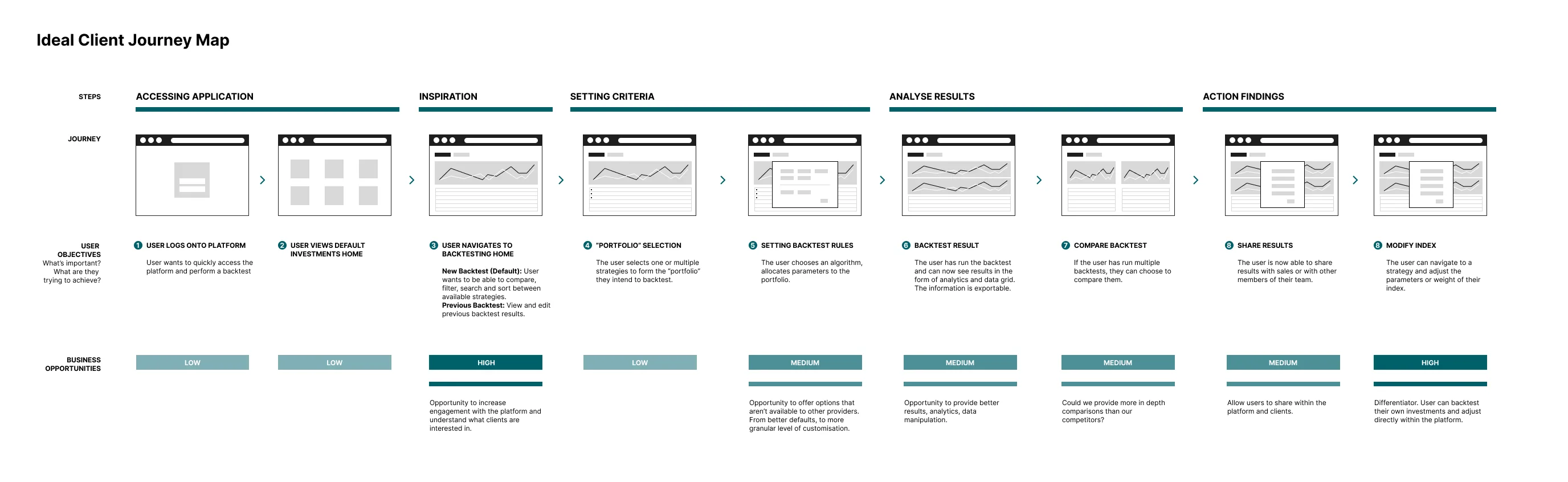
The brief was to build it inside the Strategic Indices space so clients could create, analyse and iterate strategies without leaving the workspace. Eight weeks, discovery to tested design, with two designers, four developers and a product owner.

The complexity was genuine: cross-asset building blocks, algorithmic combination testing, custom benchmarks, side-by-side comparison. And every stakeholder understood it deeply, which is exactly why each of them had one more thing they wanted visible.

The strategic question was never how do we build it. It was how do we keep it usable when everyone wants to add more.

The calls that mattered

The decision

Traders don’t need to see the engine’s full complexity to use its full capability. Nothing on screen that isn’t doing work.

Holding that line meant saying no across all eight weeks. Every addition was justifiable on its own terms, which is what makes this kind of pressure hard to resist: nobody is ever wrong, they are just each right about a different thing. The interface ended up doing four things deliberately, and the design did the absorbing so the trader didn’t have to.

Soft launch, treated as a design constraint rather than a release plan

Backtesting was novel enough at J.P. Morgan that a broad launch carried real risk. Users meeting a capability they didn’t understand could damage confidence in the wider Strategic Indices platform, so we agreed to soft launch with selected clients.

That changed what the design had to do. With low early volume there would be no learn-and-iterate at scale, so the interface had to be self-explanatory to sophisticated traders on first contact. First impressions had to land, which raised the bar on clarity rather than lowering it.

Design Studio as the alignment mechanism, not a workshop for its own sake

Seven people, a novel capability, eight weeks. The team needed shared ownership of the direction, not just shared documentation. I ran Design Studio sessions throughout: rapid sketching, prototyping and open discussion, with designers, developers and product in one room with markers and paper.

The point was never to generate more options. It was that by the time we reached wireframing, every person on the team could articulate why a decision had been made. That is what made eight weeks possible.

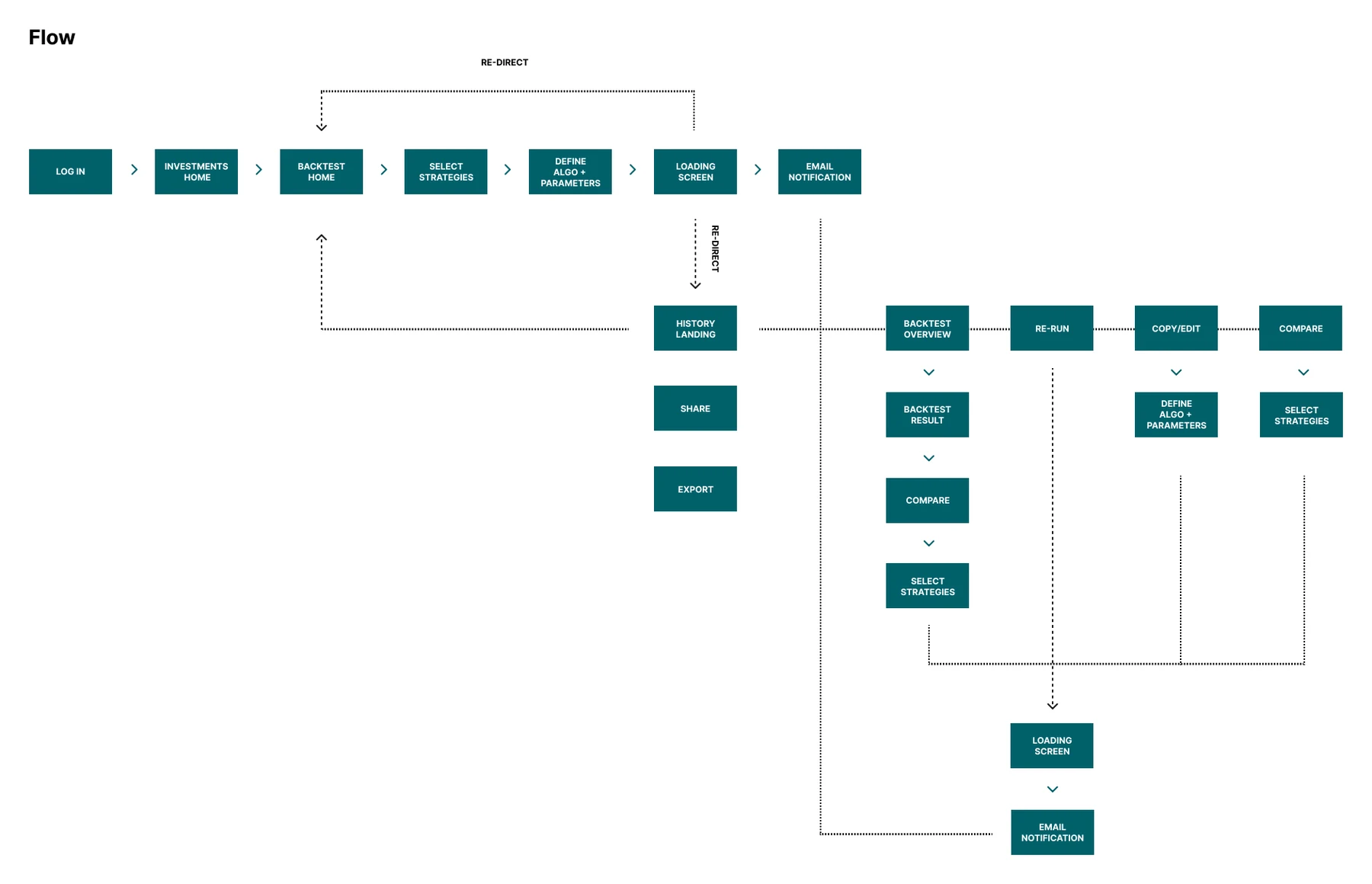
The backtesting user flow: log in, investments home, backtest home, select strategies, define algorithm and parameters, loading, email notification, with branches for history, share and export, and loops back through re-run, copy or edit, and compare.
Storyboarded before anything was drawn Storyboarding the journey before prototyping told us which edge cases deserved full design attention and which could take a simple pattern, which is where most of the eight weeks would otherwise have gone. The loops on the right are the reason the workspace had to be iterative rather than a calculator: re-run, copy and edit, and compare all return to the same four actions instead of starting again.
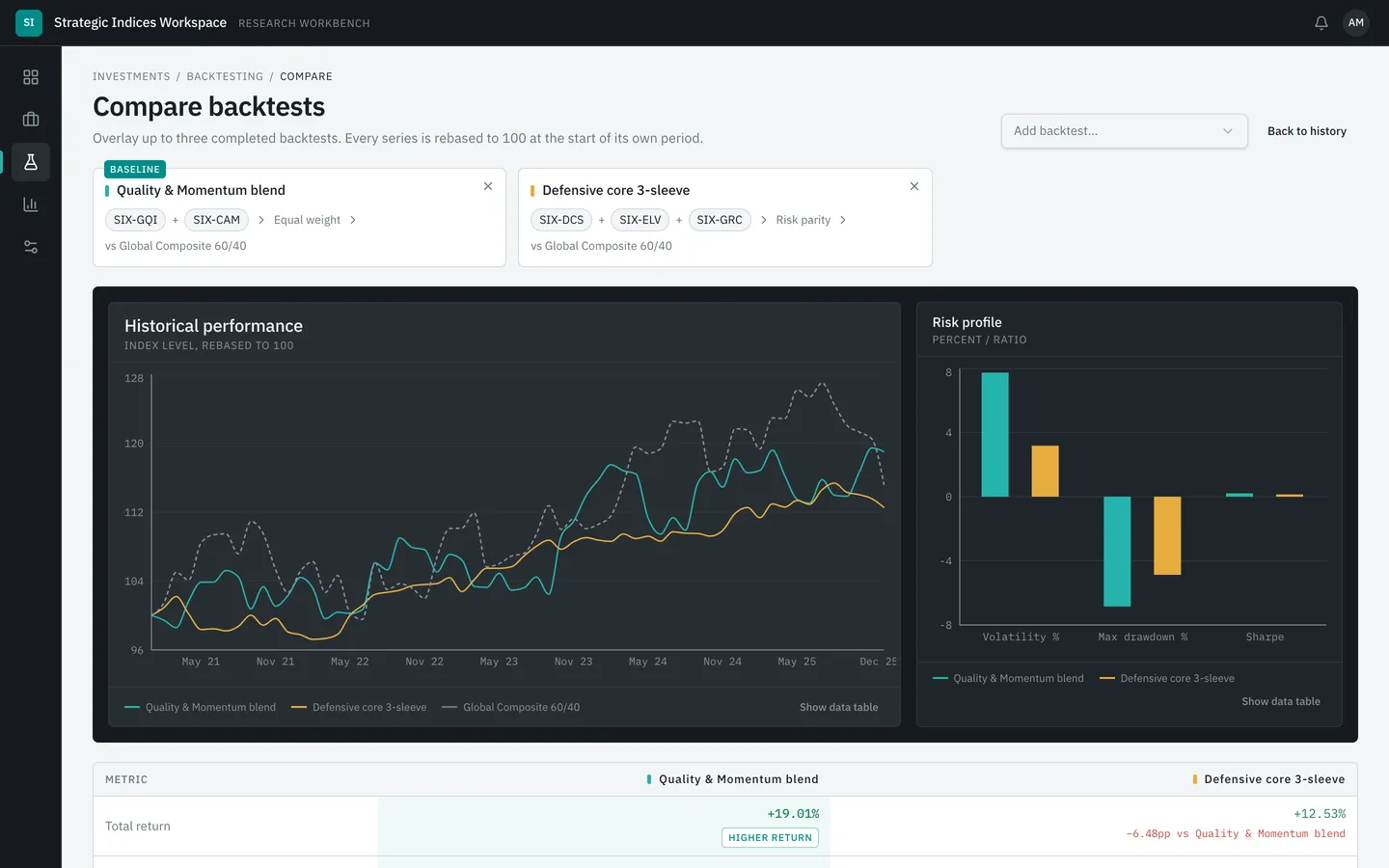
Four actions, no surface complexity View available strategies, test combinations against algorithms, compare results side by side, and create custom benchmarks. This is the same comparison as the screen at the top of the page, rebuilt from a written brief with its words back: fictional strategies, no client branding, no real market data. It is here because the thing the redaction removes is exactly the thing worth judging, and because a workspace meant to be iterated in should be clickable rather than described.

What happened

  • 8weeks, 0 to 1
  • 4core actions
  • 7people

A capability most banks send their clients elsewhere for, designed and tested inside the platform in eight weeks. Competitors rely on third-party tools. J.P. Morgan offers this in-house.

One practical thing worth stealing: the product gave us our own research pool. Strategic Indices users were already on the platform using adjacent capabilities, so validation didn’t need external recruitment and could run tightly enough to keep pace with the timeline.

This is the short version. The interesting part is which arguments I lost, and why some of them should have been lost.

Ask me about it →